
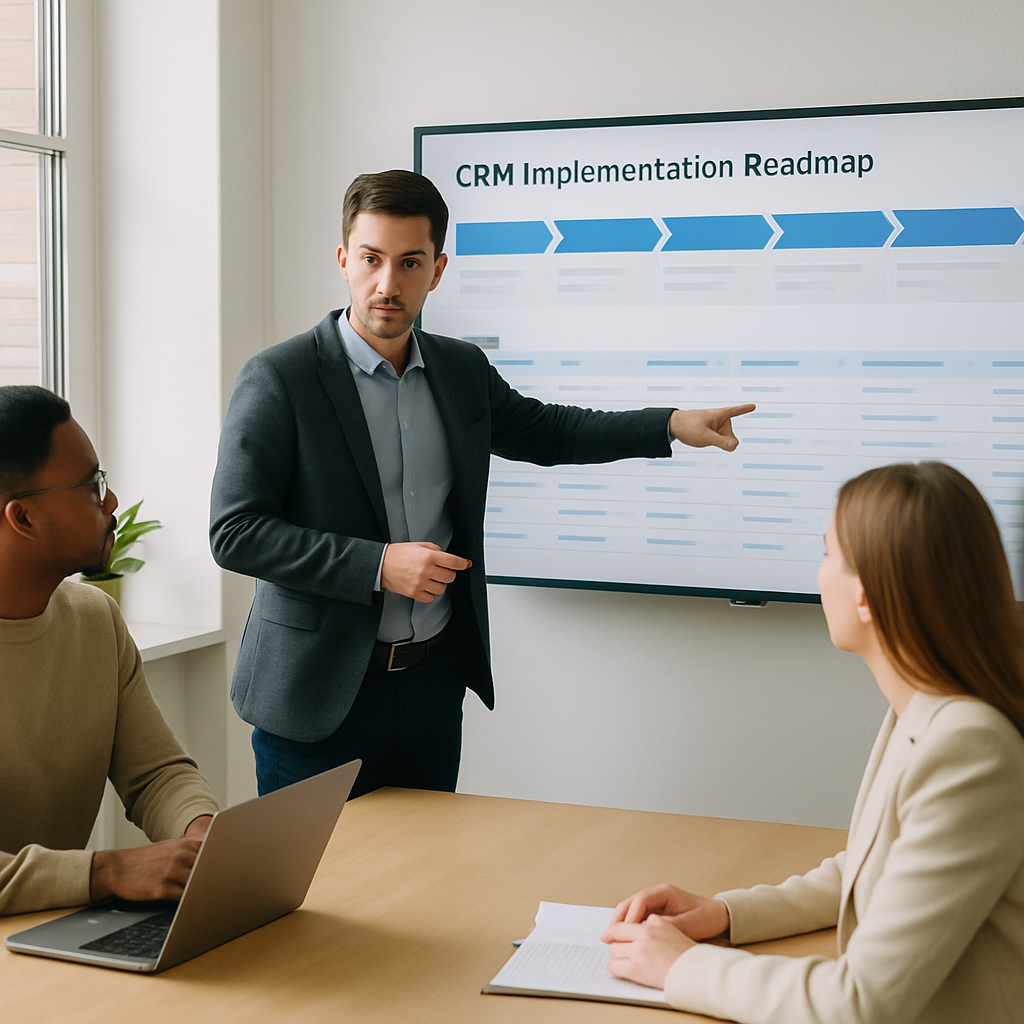
HubSpot CRM implementation done right delivers a 505% ROI over three years, with 84% of customers reporting increased revenue — but done wrong, it becomes an expensive contact database nobody trusts. I’ve run over 100 implementations, and the difference almost always comes down to how the first 8 weeks are handled. This guide walks you through every step, in the right order, so your team launches on solid ground.
Whether you’re starting fresh or migrating from another CRM, the setup decisions you make early — data structure, pipeline configuration, user permissions, integrations — determine whether HubSpot becomes your revenue engine or another tool your reps ignore.
Step 1: Map Your CRM Architecture Before Touching Any Settings
The biggest implementation mistake is opening HubSpot and starting to click before you’ve mapped out your data model. Answer four questions first:
- What objects matter? Contacts, Companies, Deals, Tickets — which are central to your business and how do they relate?
- What does your pipeline look like? Map your actual sales stages to HubSpot deal stages before creating anything in the tool.
- What custom properties do you need? Identify the fields your team actually uses to qualify leads and manage accounts — not every field from your old CRM.
- Who needs access to what? Define user roles and permission sets before inviting anyone.
Document this in a spreadsheet first. It takes a day. It prevents three weeks of rework.
Step 2: Clean Your Data Before Migrating It
Don’t move dirty data into a clean system. Run these checks on your existing database before importing a single record:
- Deduplicate — merge or delete duplicates. Expect 10–30% duplication in untreated databases.
- Standardize field formats — phone numbers, country codes, company names. Inconsistent formatting breaks segmentation and reporting.
- Remove dead records — contacts with no engagement in 3+ years, invalid emails, and test records.
- Validate required fields — every contact that matters needs: first name, last name, email, company name.
For a database with 50K+ records, budget 3–4 weeks of real data work. Our HubSpot onboarding and migration services include a full data audit as part of every engagement — what you import on day one defines your data quality for years.
Step 3: Configure Your Account Structure
In this order:
- Company settings — fiscal year, currency, time zone, and connected domain. These affect reporting immediately.
- Custom properties — build only what you need. Use the CRM architecture doc from Step 1.
- Pipeline and stages — build deal pipelines with accurate stage names and realistic close probability percentages. Multiple sales motions need separate pipelines.
- Lifecycle stages — define the criteria for each transition: Subscriber → Lead → MQL → SQL → Opportunity → Customer.
- User roles and teams — set permissions before inviting anyone to the portal.
Step 4: Connect Your Tech Stack
Priority integrations for most B2B teams:
- Email client (Gmail or Outlook) — two-way logging and Sequences from the inbox
- Calendar — powers Meetings booking pages
- Website tracking code — contact activity, page views, form submissions
- Ad accounts — Google Ads, LinkedIn, Meta for accurate lead source attribution
- Existing CRM or ERP — if running parallel systems, define sync rules before go-live
Get integrations running before user training so reps see a working system, not a half-built one.
Step 5: Train by Role, Not by Team
A 2-hour “HubSpot overview” for the whole company teaches nobody anything useful. Run role-specific sessions:
- Sales reps — Contact records, deal management, email Sequences, activity logging, Meetings links
- Sales managers — Pipeline views, forecasting, deal reports, team dashboards
- Marketing — Lists, forms, email tools, Workflows, campaign attribution
- Admins — Property management, Workflow configuration, user permissions, data quality tools
HubSpot Academy certifications are free — make them a go-live requirement, not optional afterthoughts.
Step 6: Launch in Phases, Not All at Once
Roll out in controlled phases to catch issues before they affect everyone:
- Weeks 1–2: Power users and team leads only. Let them surface the edge cases.
- Weeks 3–4: Full team rollout with fixes from Phase 1 already in place.
- Months 2–3: Monitor adoption weekly, run refresher training for lagging teams, begin building automation on top of the clean foundation.
Track weekly: what percentage of reps are logging activities, creating contacts, and advancing deals? If adoption falls below 70% in the first 90 days, address it immediately — the platform only delivers results when people use it.
Frequently Asked Questions
How long does a HubSpot CRM implementation take?
For a mid-market company (50–500 people), a full HubSpot CRM implementation typically takes 8–12 weeks from kickoff to go-live. A simple Sales Hub setup with clean data can be done in 4–6 weeks. Multi-hub implementations (Sales + Marketing + Service) with complex integrations run 12–16 weeks. The biggest time variables are data quality and stakeholder availability for reviews and approvals.
How much does a HubSpot CRM implementation cost?
A basic self-guided setup costs nothing beyond your HubSpot subscription. A professionally guided implementation through a certified HubSpot Solutions Partner typically runs $15K–$60K depending on scope, data complexity, number of integrations, and training requirements. Full-scale enterprise implementations with custom integrations can reach $80K–$150K. At any price point, a well-executed implementation pays for itself — poorly executed ones cost far more in lost productivity and rework.
What data should I migrate from my old CRM?
Migrate active contacts, open deals, account records, and the last 12–18 months of relevant activity history. Don’t migrate every record from the past decade — old unengaged contacts inflate your contact tier and your bill. Archive or delete anything that hasn’t engaged in 2+ years before migration. Historical closed-won deals are worth keeping for reporting context; historical closed-lost with no notes are not worth the import overhead.
Do I need a HubSpot Solutions Partner to implement it?
You don’t need one, but most teams that self-implement spend 2–3x longer reaching value and miss critical configuration steps that limit automation and reporting accuracy. A certified HubSpot Solutions Partner brings a proven process, knows the common failure points, and compresses a 6-month self-guided setup into 10 weeks. For teams with more than 25 users or complex data migrations, a partner typically pays for itself within the first year.
What’s the most common reason HubSpot implementations get stuck?
No dedicated internal owner. Every successful implementation has one person — a Sales Ops manager, RevOps lead, or HubSpot admin — who owns the configuration, enforces usage standards, and manages ongoing updates. When implementation is treated as a one-time project with no permanent steward after go-live, adoption decays within 90 days and the platform never delivers on its potential.
Build It Right the First Time
The companies that get the most from HubSpot are the ones that invested in doing the implementation correctly upfront — clean data, clear architecture, role-specific training, and a phased rollout. The ones that struggle are the ones that rushed to go-live without those foundations in place.
If you’re planning a HubSpot CRM implementation or cleaning up one that went sideways, book a call with Your HubSpot Expert. We’ll map out your architecture, handle the migration, and get your team trained and running — done right the first time.
Need expert help implementing HubSpot the right way? Work with Your HubSpot Expert — we handle setup, automation, and ongoing support so your team actually gets results.